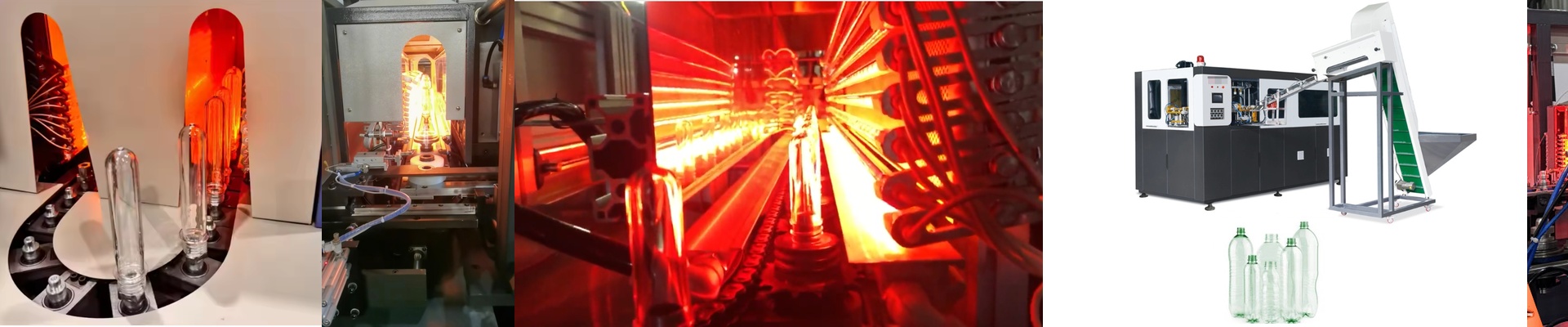
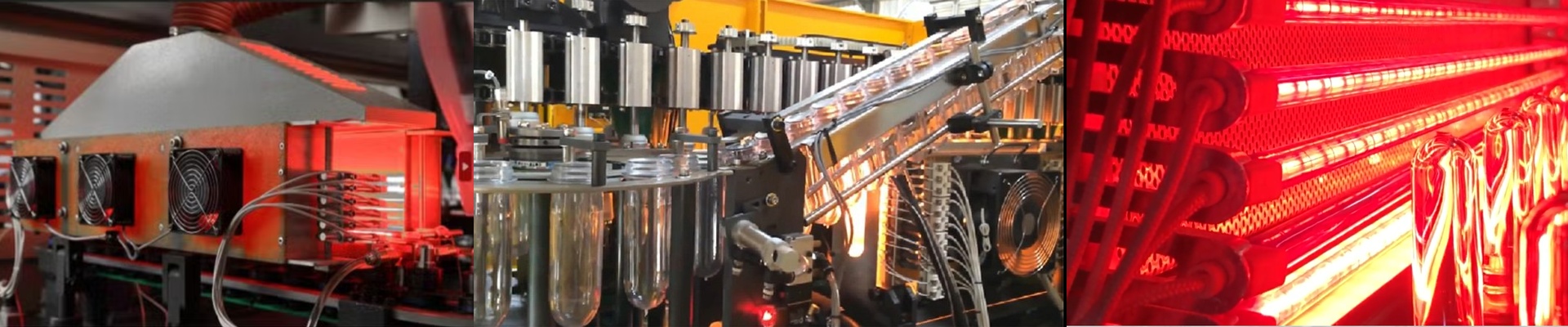
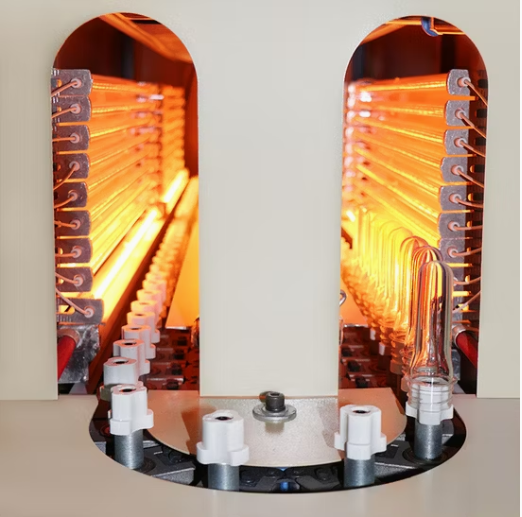
On the production floor, the heating tunnel is where the pressure really shows. Underheated preforms come out of stretch blow molding with those telltale white stress marks. Overheated ones fold in the mold. When the halogen or quartz emitter starts to drift, you pay for it in scrap and downtime.
What matters under the hood
We build linear blow molding machine emitters to OEM-equivalent specs, using short-wave infrared. For Sidel, that means a 1,600 mm quartz tube at 2,000 W, 230 V, with an R7s base and a 10 mm OD sheath that sits right in the reflector geometry. For Krones, it’s a 1,800 mm unit at 2,400 W, 240 V, same R7s interface, and a tungsten filament tuned to hit the spectral peak for fast, even preform heating. On Husky and SIPA lines, we match length, wattage, voltage, and connector type so the lamp drops into the existing mounts and wiring without any rework.
Why this matters on the line
When the parameters line up 1:1, you get a repeatable preform heating profile without chasing the whole tunnel. That translates to fewer rejects from uneven wall thickness, and cycle rates that hold steady because the lamp comes up to temperature quickly and stays there. Energy use comes down since the emitter heats on demand, and lamp life stays solid at 5,000+ hours with less than 5% output drop—fewer unplanned changeouts.
The practical details
Installation is straightforward: verify voltage, polarity, and reflector condition before you swap. Keep the emitter clean and aligned—dust on the quartz tube will throw off the heat pattern. These lamps are rated for continuous duty in standard heating tunnels, but they aren’t compatible with water-cooled holders unless the sheath and seal are spec’d for that. Match wattage and length to the machine, and you keep the line moving.